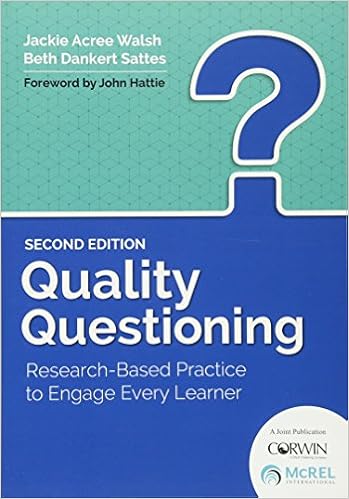
I have learned so much as I read through the book “Quality Questioning - Research Based Practice to Engage Every Learner.” I am very excited to use the strategies I have studied in my classroom. In Chapter 1, I read about the Cycle of Quality Questioning. To implement this into my classroom I have to first commit to making "questioning" part of my planning and designing phase of my lessons. I have to practice formulating questions that will promote deeper discussion and allow my students to make stronger connections. I also have to break the habit of only calling on “target” students and allowing some students to “opt out” of answering. I will need to develop better strategies for checking students' responses so that everyone feels like their responses matter and have value. By working to implement these behaviors and procedures, I can be sure that my students will become more engaged in my lessons and acquire a deeper understanding of the content.
Chapter 2 focuses on how teachers can prepare Quality Questions. The rubric on page 24 is a useful tool for evaluating the questions prepared for a lesson. I would apply this rubric for checking the quality of my focus questions. I would begin by sitting down with my content partner (we both teach Reading) and collaborating on our focus questions. We would need to look closely at the standard and think about the verbs that are used. We would need to take into account the prior knowledge of our students and be sure the questions spark our students’ interest. We will also need to be sure the question is worded to prompt deeper thinking and have a clear strategy for checking students’ responses. I think we would need to seek out resources and look at many examples as we develop this skill. It will take practice and time, but I think having this rubric will help us learn to create stronger, more engaging questions.
Chapter 3 instructs on presenting the question and hearing student responses. In this chapter, I read about many different ways for students to respond. Several of these resonate with my teaching style. In my classroom I try to maintain a positive learning environment. I strive to teach respect and kindness from day one. I promote showing respect when we have different opinions and encourage students to listen to one another. To check responses, I definitely use signals for quick "who is paying attention and engaged" checks. I make sure all my students feel “safe” when using signals and do not tolerate laughing or making fun of one another. In reading, I implement think, pair, share in our reading journals. Many of my 5th graders are more likely to share with a peer than out loud to the entire class. I think talking with a partner sometimes helps my students “practice” so they are ready to share aloud to the class.
Chapter 4 discusses how teachers can encourage deeper responses from students by implementing “think time” during discussion. To do this in my own classroom, it will take practice and patience. As a teacher, I often feel as though I am “fighting” the clock to squeeze as much as possible into my day. After reading, I can better appreciate the value of purposeful “think time” when questioning students. When everyone has time to process, there can be more participation. Students have more time to formulate evidence and justification of answers. As a teacher, I am giving myself time to think and react. This is something I will need to model with my class. I am sure it will feel awkward at first, but will be a valuable strategy with practice. I will have to be very mindful about not allowing my lower students to “opt out” of participating. When everyone is held accountable, everyone is more likely to be engaged and will benefit from the discussion.
Chapter 5 explains how to react to student responses. After reading the chapter, I believe a challenge for me will be when the student response shows the student is on track with his or her learning. This is a challenge because I typically praise this student and move on. I do not usually give “feedback” that causes the student to think deeper. With so many students below grade level and struggling with the content, I find it challenging to prompt students who easily grasp the content. Like the other strategies I have read about during this module, I believe I can become more successful with practice and collaboration with my colleagues.
Sattes, Jackie Acree Walsh; Beth D. Quality Questioning. SAGE Publications, Inc. (US), 2017. [Yuzu].


No comments:
Post a Comment